
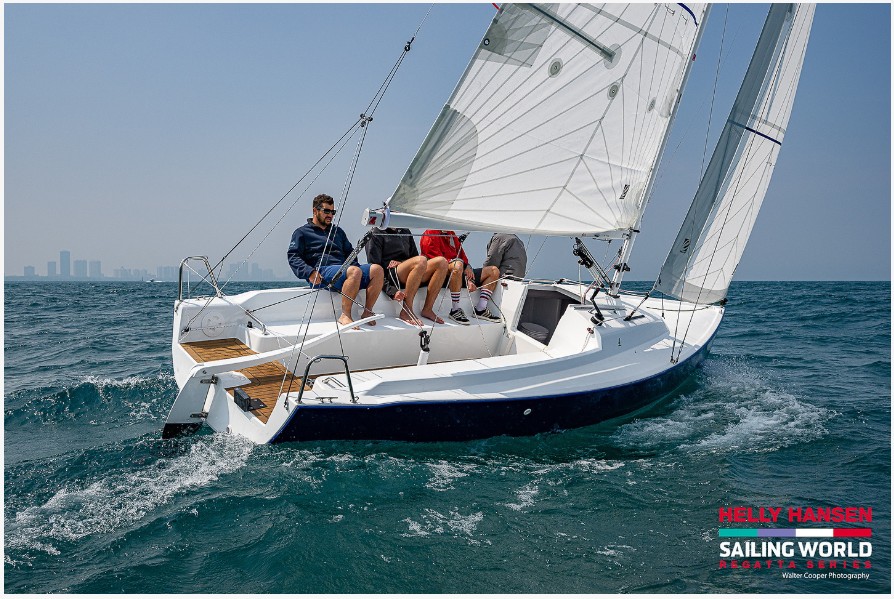
Photo Credit above Walter Cooper Photography/HHSWRS
A year ago, J/7 hull #2 landed on our doorstep right at the start of the season in Chicago. As one of the newest J/Boats dealers, it was a real thrill to be the ones putting the newest model through its paces, and we’re grateful to J/Boats for making it happen in time for the season. Here’s what a full year with the boat actually looks like.
Delivery & Setup
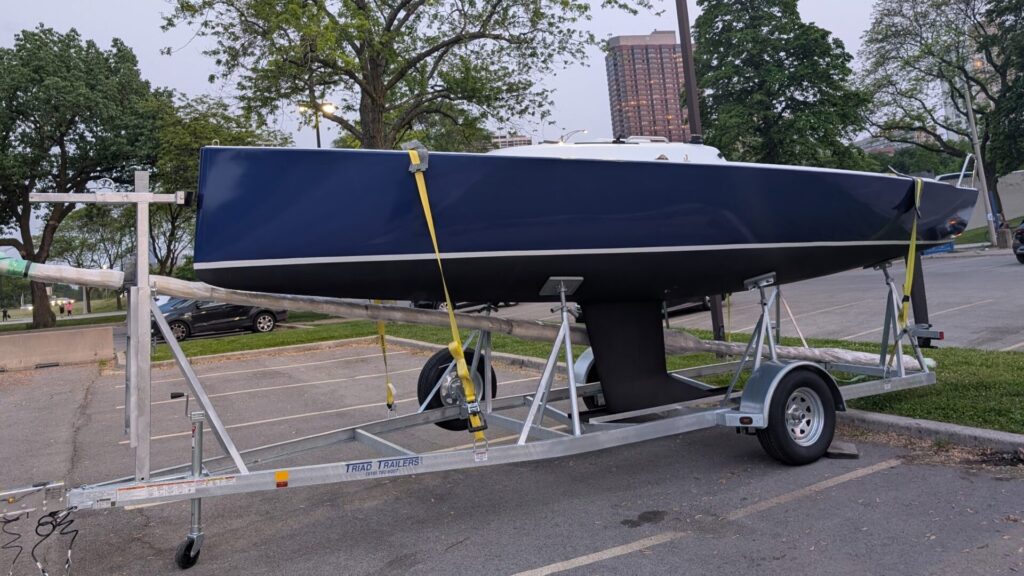
The boat showed up on a new Triad trailer. All-up weight is just over 3,000 lbs, so most larger SUVs can tow it without any drama. We assembled her in the yacht club parking lot, which took most of the morning as we figured things out, but it was a fun process.
Raising the rig was a breeze, even in 30 knots of actual breeze. Once we had the shrouds and spreaders sorted, we attached the pin at the mast base that acts as a hinge, walked the rig upright with three people, pushed it forward, and clipped the headstay. Simple. After the initial set up two experienced sailors can rig and step the rig in a couple of hours.
Getting her in the water was equally painless. The draft is shallow enough and the weight low enough that any standard 1.5-ton yacht club crane can handle the lift. We used a single-point lift pin with a webbing loop and added a couple of guide lines to keep things steady. The only wrinkle was balancing the boat with the rudder and engine on, and we ended up tossing some sails and the cooler in the bow. A few transom guide lines would sort that permanently.
On the Water
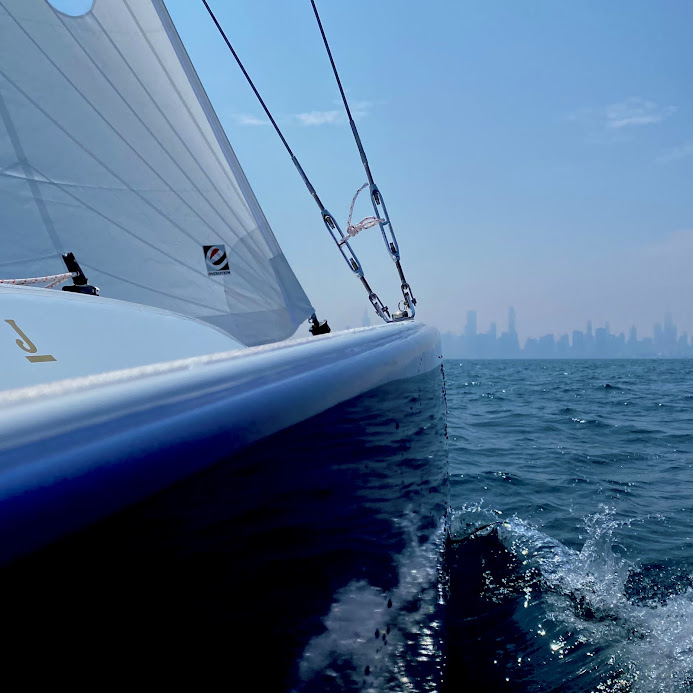
First-time rigging felt a lot like setting up a J/70. The original zipper luff jib slides up easily, and the mainsail feeds into the mast on slides. The clean deck layout made the running rigging pretty self-explanatory. We were also testing a new set of Evolution Sails at the same time, which added to the excitement. Good news for new buyers: all boats are now being delivered with an upgraded Harken Mark IV furler with a headfoil and luff tape, replacing the zipper luff system for smoother, easier furling.
Our first sail was a cruise from Belmont Harbor to Monroe Harbor for the Helly Hansen Regatta. Two things hit us right away: the space and the speed. Four adults in the cockpit and nobody felt cramped. And instead of the slow cruiser I was half expecting, the boat just moved, light and sporty, effortless through the water. We shadowed the J/70 fleet upwind and honestly weren’t far off their pace. For a boat that weighs 600 lbs more, that’s pretty impressive.
The Two Big Things
After spending more time on the boat, two strengths really stood out.
Stability. We tried everything we could think of to upset this boat, and it just wouldn’t play along. Asymmetrical up, high reach, full trim, nobody hiking and we couldn’t make it wipe out. The keel bulb keeps the center of gravity nice and low, and the boat always comes back upright. Even pushing close to rail-down, you’ve still got full control.

Simplicity. This thing is genuinely easy to sail. I took my two-year-old daughter and my pregnant wife out for a daysail. Five minutes of prep, mostly loading the cooler, and fifteen minutes later we were sailing at 5 knots with a light helm and not a care in the world. No traveler to fuss with, jib sheets on a 2:1 with a Harken snub air winch, and cunningham and vang are your only other controls.
Maneuvers are dead simple: cleat the main, turn the boat, two pulls on the sheet. Done.
Derigging is just as quick. Furl the jib, drop the main, tidy the flakes and toss the cover on, and you’re off the boat before the dock lines are even cleated. Ten minutes if you include a post-sail beer, which you should.
The Interior
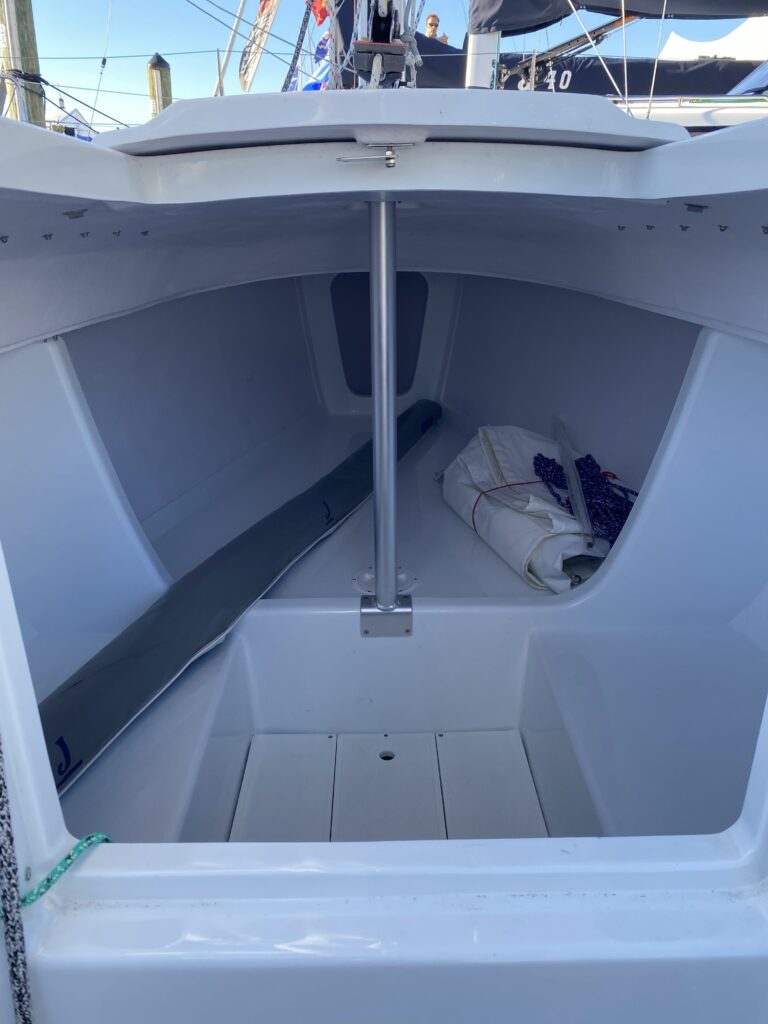
The cabin is simple but surprisingly effective. There’s plenty of room for a cooler, a few spinnakers, and everyone’s gear without feeling like you’re playing Tetris before every sail. It’s not a cruising cabin by any stretch, and any full-sized adult who tries to sleep down there will quickly reconsider their life choices. But for stowing gear and keeping things organized, it does exactly what you need it to. And on more than one occasion this past season, I’ve found one of my daughters happily napping down there while the adults sorted out the dock lines. For that, it’s perfect.
As a Training Boat
We’ve been running the J/7 as a training platform for sailing clubs and think it’s going to be a real hit. I spent a lot of summers teaching in J/22s, which were a great boat, but the J/7 is better in every way. Faster, easier to sail, more comfortable, more room. The stern platform is perfect for an instructor to stand and coach from, and the cockpit fits four or five adults easily, more if they’re kids.
One Design Class Racing
For those looking to add a little friendly competition to the mix, a proposed one design class ruleset is in development and it fits the spirit of the boat perfectly. The class is built around a simple Dacron sail plan, with the jib required to stay on the furler with a UV cover and the main on slides, just like you’d sail it any other day. Legs in is required for sailing, J/22 style, keeping everyone comfortable on longer races. The rules are deliberately straightforward, designed to keep the focus on fun and fair racing rather than equipment wars or complicated tuning. It’s the kind of class where you show up, sail hard, and enjoy the day without the fuss.
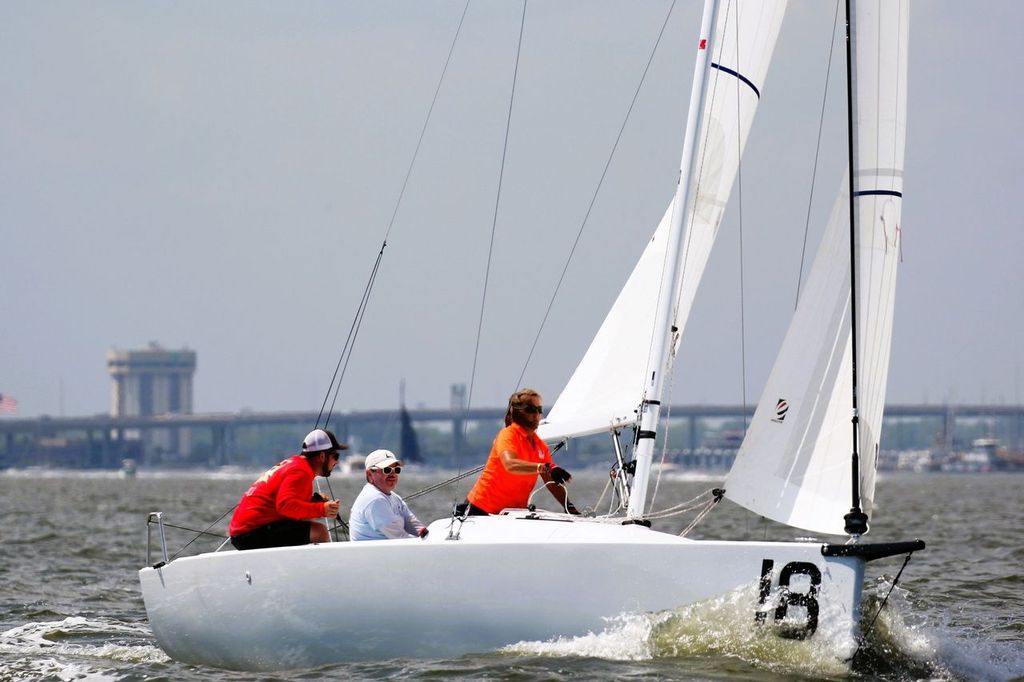
The first official one design event took place this spring at Charleston Race Week, and it was a great debut. Six J/7s lined up for three days of tight, competitive racing with the close mark roundings and fleet battles that make one design sailing so much fun. If Charleston is any indication of what this class is going to look like, we’re in for a great time on the racecourse.
The Bottom Line
After a full season with hull #2, we’re convinced the J/7 is one of those rare boats that genuinely does it all. For the sailor who wants to get out on the water without the fuss, it’s about as close to effortless fun cruising as we’ve seen in a boat this size. For sailing schools and instructors, the combination of stability, simplicity, and space makes it one of the best learn-to-sail platforms on the market. And for those who want to mix it up on the racecourse, the J/7 is quick, responsive, and easy enough to sail fast that you can actually focus on racing rather than boat handling.
Interest in the boat reflects all of that. The first 80 hulls are already spoken for, with the next available slots opening up for late 2026 delivery. If you’ve been on the fence, now is the time to get in line. And if you want to skip the wait and get on the water this season, our demo boat, hull #2, is available for sale. Reach out to us at J/Boats Midwest to learn more. Contact Us
For more information
See Our J Boats Midwest Dealership
J Boats Midwest
Learn More About Evolution Sails Chicago
Evolution Sails Chicago
Explore Our Learning Center
Learning Center